
Seeing the Story: Why Visualization Skills Matter for Reading Comprehension
By: The Kid’s Directory Family Resource Guide – Houston
May 2026 on kids-houston.com
Why Visualization Skills Matter for Reading Comprehension
For many children, reading begins as a process of sounding out letters, decoding words, and trying very hard not to lose their place every three seconds. At first, success often looks simple: recognizing vocabulary words, reading aloud smoothly, and remembering where the period goes. But true reading comprehension—the ability to deeply understand, connect with, and remember what is being read—requires something much bigger happening behind the scenes.
It requires the brain to create meaning.
One of the most important tools children use to build that meaning is visualization.
Visualization is the mental process of creating images, scenes, actions, emotions, and connections while reading. In other words, it is the brain’s ability to turn words into “mental movies.” When children visualize effectively, they are not just reading a story about a stormy night; they can almost hear the thunder, picture the lightning flashing across the sky, and feel the character’s nervousness while walking through the dark woods.
Reading suddenly becomes an experience instead of a decoding exercise.
For many adults, visualization happens so naturally that they hardly notice they are doing it. Ask someone to read the sentence, “The little boy jumped into the giant pile of crunchy autumn leaves,” and most people instantly imagine colors, sounds, movement, and maybe even remember the smell of fall. The brain automatically transforms words into imagery.
Children who can do this tend to understand what they read more deeply because visualization helps the brain organize and store information. The words stop floating around like random puzzle pieces and begin connecting into meaningful concepts.
Without visualization, reading can feel like trying to assemble furniture using instructions written in another galaxy.
How Visualization Strengthens Reading Comprehension
Visualization acts like a bridge between words and understanding. When children form mental images while reading, the brain becomes more actively engaged. Instead of passively looking at words on a page, the child begins interacting with the text.
This process strengthens comprehension in several important ways.
First, visualization improves memory. The brain remembers images more effectively than isolated words. That is why many people can recall scenes from a movie years later but struggle to remember a paragraph they read yesterday. Mental imagery gives information structure and emotional meaning, making it easier to store and retrieve later.
Second, visualization helps children follow sequences and events. When a child can picture what is happening in a story, they are better able to understand cause and effect, character motivations, and changes in setting or mood. They can mentally “track” the action instead of getting lost in a sea of sentences.
Third, visualization increases engagement. Children who create mental images while reading often become more emotionally connected to stories and information. Reading feels less like homework and more like participation. This connection is critical because engagement fuels motivation, and motivated readers practice more frequently.
Visualization is also important beyond fictional stories. It plays a major role in understanding nonfiction, science, history, and even mathematics. A child reading about the water cycle benefits from mentally picturing evaporation, clouds forming, and rain falling. A student learning geometry often needs to mentally manipulate shapes and spatial relationships. Visualization supports comprehension across nearly every academic subject.
An Example of Visualization in Action
Imagine two children reading the following sentence:
“The exhausted golden retriever collapsed beside the muddy river after chasing the bright red ball through the rain.”
The first child naturally visualizes the scene. In their mind, they see the wet dog panting heavily, muddy paws splashing near the riverbank, rain falling, and the bright red ball resting nearby. Because they can picture the action, they understand not only what happened, but also the mood, setting, and energy of the moment.
The second child reads every word correctly but forms no mental image at all. The sentence remains a collection of disconnected facts. They may know what the individual words mean, yet still struggle to fully grasp the scene or remember it later.
Now imagine this difference multiplied across entire chapters, textbooks, classroom assignments, and years of education.
That gap becomes significant very quickly.
When Visualization Does Not Come Naturally
One of the biggest misconceptions about reading comprehension is the belief that all children automatically develop visualization skills simply by learning to read. In reality, some children do not naturally create mental imagery while reading. Others create only vague or incomplete images. Some children may struggle to visualize because of language-processing difficulties, learning differences, attention challenges, or weaknesses in working memory.
For these children, reading can become exhausting.
They may decode words accurately but still fail to understand what they just read. Parents and teachers often become confused because the child appears capable of reading aloud fluently, yet cannot answer comprehension questions afterward. The child may reread the same paragraph multiple times without gaining meaning because the words never transform into a cohesive mental picture.
This can lead to frustration on all sides. Adults may mistakenly assume the child is not paying attention or is simply rushing through assignments. Meanwhile, the child may feel confused, embarrassed, or discouraged because they genuinely do not understand why reading seems so much harder for them than for their peers.
Children with weak visualization skills often experience difficulty with sequencing events, making predictions, identifying main ideas, recalling details, and understanding abstract concepts. They may also struggle with writing because effective writing often relies on the ability to mentally organize and picture ideas before expressing them on paper.
In classroom settings, these struggles can quietly snowball.
The Short-Term Impact of Reading Struggles
In the short term, children who struggle with reading comprehension often begin falling behind academically. Since reading is tied to nearly every subject in school, comprehension difficulties affect far more than language arts grades.
Science instructions become harder to follow. Word problems in math feel confusing. Social studies chapters seem overwhelming. Even classroom discussions become stressful when students cannot fully process assigned readings.
These children may begin avoiding reading altogether because it feels mentally draining. Instead of experiencing curiosity and enjoyment, they associate reading with frustration, confusion, and failure. Homework can become a nightly battle involving tears, exhaustion, and negotiations that would impress international diplomats.
Confidence often takes a major hit.
Children quickly notice when classmates understand material more easily. They may stop volunteering answers in class, avoid reading aloud, or develop anxiety around schoolwork. Some children become quiet and withdrawn, while others mask their struggles through avoidance, humor, or disruptive behavior.
Teachers and parents may also notice reduced attention spans during reading activities. This is not always because the child lacks focus. Sometimes the brain simply disengages when comprehension repeatedly breaks down.
The Long-Term Impact of Reading Difficulties
If comprehension struggles remain unaddressed, the long-term consequences can extend far beyond elementary school.
Academically, reading demands increase dramatically as children grow older. Around third and fourth grade, students transition from “learning to read” toward “reading to learn.” Texts become longer, vocabulary becomes more complex, and assignments require greater critical thinking. Students who lack strong comprehension foundations often experience widening achievement gaps over time.
Poor reading comprehension can impact grades, standardized testing performance, classroom participation, and overall academic confidence. Students may begin believing they are “bad at school” when the real issue is that they are not accessing information effectively.
Outside of school, reading difficulties can affect everyday life as well. Children who struggle with comprehension may avoid books, instructions, menus, games, or activities involving significant reading. This can limit opportunities for independent learning and exploration.
There are also emotional and social effects to consider. Children who repeatedly experience academic frustration may develop anxiety, low self-esteem, or feelings of inadequacy. Over time, some students begin defining themselves by what they cannot do rather than recognizing their strengths and potential.
The good news is that visualization skills can be taught, strengthened, and practiced.
Visualization is not a magical talent reserved for naturally gifted readers. It is a skill that can be intentionally developed through guided instruction and practice.
Importantly, struggling readers often need patience and explicit support rather than pressure. Telling a child to “just focus harder” rarely solves comprehension problems. Teaching the brain how to actively construct meaning is far more effective.
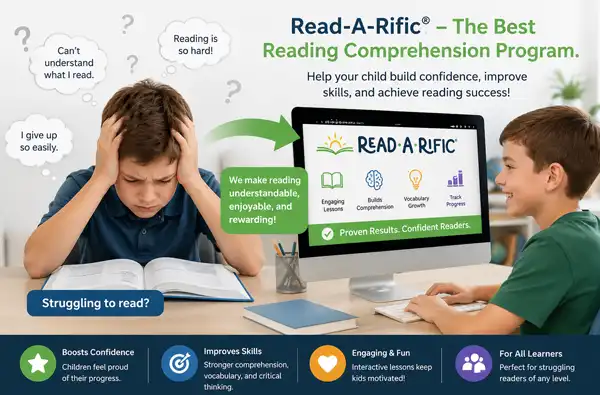
Read-A-Rific® is an affordable, step-by-step online reading comprehension program that teaches the foundational skill of visualization in short, guided sessions — approximately 15 minutes a day.
Read-A-Rific® is about strengthening the process behind comprehension, not about adding more practice that will never address the issue with a solution. Reading together every night, extra tutoring, repeating directions, incentives and reward systems often focus on performance. Visualization focuses on foundation.
While the Read-A-Rific® programs are geared toward 3rd to 6th graders, older students can benefit as well because the concept is the same. Adults use the program as well.
All the programs have unlimited access and can be used by multiple students.
Affordable for all and payment plans available through Affirm (3, 6, or 12 months)
Use code SAVE10 to get 10% off the 60 session reading comprehension programs and bundles.
Read-A-Rific® is a vendor for various schools & ESA Scholarship Programs across the country, including Texas PDSES, TEFA -Texas Education Freedom Accounts and continues to grow.
Created by a Mom for Mom’s
Janel Nansenn, M.A., is an Educational Therapist, author, speaker, online course creator and founder of Read-A-Rific®, LLC.
Janel earned a Master’s degree in speech-language pathology and audiology, and over the years, has established five successful private practices/learning clinics in four different states, helping many clients from the age of five through adulthood become independent learners.
With much program success recognized by Parents/Guardians, Homeschoolers, Schools & Doctors, Janel became even more inspired to make Read-A-Rific® available to everyone because she believes that every child deserves to feel capable and confident in their learning!
Why Visualization Matters More Than Ever
In today’s fast-moving world, children are constantly surrounded by visual media. Movies, videos, games, and digital content provide instant imagery without requiring the brain to generate it independently. While these forms of entertainment are not inherently harmful, they can reduce opportunities for children to practice creating internal imagery through reading.
Visualization remains essential because it builds deep thinking, imagination, creativity, empathy, and understanding. When children visualize while reading, they step inside experiences beyond their own lives. They learn to imagine perspectives, environments, and emotions they may never encounter personally.
Books become more than assignments.
They become adventures, discoveries, conversations, and opportunities for growth.
Strong visualization skills help children move from simply reading words to truly understanding ideas. They transform reading from a mechanical task into a meaningful experience. For children who struggle with comprehension, learning to visualize can open doors academically, emotionally, and socially.
And perhaps most importantly, it can help children discover something every lifelong reader eventually learns:
The best stories do not just live on the page. They come alive in the mind.
Reference - Testimonial
Watch YouTube Influencer eSchooled with Amanda Melrose interview Janel Nansenn, M.A. and discusses how Read-A-Rific® worked for her daughter!
Related Blog Articles:

For Back To School
Homeschooling, Schools, After School Programs, & Activities:
The KD Family Resource Guide!
Providing the best schools, after-school activities, field trips, Spring & Summer Camps and activities, ABA Therapies, medical services, pediatric & family dentistry, museums, libraries, parents night out, kids eat free, retail, everything for birthday parties, holiday activities & events, festivals, and so much more!
We not only provide resources in Houston but south to Galveston, west to Rosenberg & north to College Station. Resources not only for kids & families but also for those with kids looking for some much needed “me time”.
Need to take a break from the routine to have some fun and create lasting memories? Check our Calendar Of Events for constantly updated fun and exciting activities & events for your kids and family.
We are always updating resources, adding more options & even creating new sections on our website for more resources. So be sure to check back often or just come hang out to read a blog.
The Kid’s Directory is Houston & the surrounding area’s most respected and trusted family resource guide that can ease your life. It covers all the different activities available for families with children of all ages. Ranging from activities, spring/summer & winter camps, academics, pediatricians, dentists, therapy, events to sports, other cognitive activities and more. Follow us on Facebook and Instagram.
© The Kid’s Directory. Accessing this content you agree to our disclaimer/terms & conditions.
As an Amazon Associate we earn from qualifying purchases.